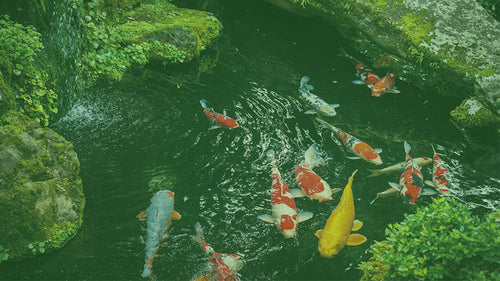
Goromo is a koi variety with a white (shiroji) base color, a red (hi) pattern, and dark blue to black markings (anime) on the hi pattern. The hi pattern can be classified as a "saddle pattern" ( see Buying Koi (part 4 ) ). Essentially, it's a Kohaku with the anime added as an extra. This anime is preferably dark blue/purple. It's important that the amine only appears on the hi pattern, preferably as evenly distributed as possible. If it also appears on the shiroji, it's considered a negative point for judging at a koi show. Goromo literally means "robe." With a little imagination, you can see the anime-adorned red pattern as a kind of garment over the bare white base color. Goromo is classified in the Koromo show class at koi shows. This show class includes not only Goromo but also the very popular Goshiki.
Origin
Goromo originated from a cross between Kohaku and Asagi. Goromo owes its matsuba (pine cone)-like markings to the Asagi ( Asagi and Shusui ). The influence of Kohaku is clear. Goromo is also a white fish with a red saddle pattern. The red of Goromo is often somewhat brighter than that of Kohaku, this is due to the bright red of the Asagi. While red on the pectoral fins of Kohaku is undesirable, it is permitted in Goromo. The reason for this is that many Asagi have red on the pectoral fins, and since the Asagi genes are part of Goromo, it is common in this variety. Ideally, it should be present in equal amounts on both sides.
Breeding
There are no (well-known) breeders in Japan who exclusively raise Goromo. You have a chance of finding good specimens of Conias, Takigawa, Maruju, and Takatatsu. Furthermore, many bulk breeders do have some Goromo in their assortment. The selection criteria for young Goromo are very similar to those for Kohaku. The anime often doesn't develop until later in life, so it's not possible to select for it in the first few months after birth. Besides a good body, of course, the search is for a base color as white as possible with a nicely balanced "Kohaku" pattern. The later the anime develops, the better it generally becomes. Especially in "hard" water, such as is common in the Netherlands, it can quickly become too much and therefore too messy/dominant. Too much is harmful!
Subvarieties
The most famous appearance is the Ai Goromo . Ai stands for indigo. Blue-purple half-moons ideally form the even markings on the ends of the scales of the hi pattern. Since there are no scales on the koi's head, there should be no anime on the head. Budo Goromo The amine covers small clusters of scales in the hi pattern. Budo means grape. The ani gives the impression of bunches of grapes. In the Sumi Goromo, the ani is black (sumi means black) and covers almost the entire hi pattern, giving the hi pattern a brownish-purple appearance.


Joop van Tol (www.koitoday.nl)

Sign up for our newsletter
Receive the best offers and personal advice.
cookie preferences
To provide you with better, more personalized service, we use cookies and similar technologies. We and third parties use cookies to track your browsing behavior on our website. More information can be found on our privacy policy page.
 Nederlands
 Deutsch