In previous parts of this series Buying Koi Part 1 we have seen that four things are important when evaluating and purchasing koi; Body Buying Koi Part 2 , skin quality Buying Koi Part 3 : Pattern and Elegance. In this part, we delve deeper into the pattern.
Cartridge
Beginning hobbyists focus primarily on the pattern. I can't emphasize enough that body and skin quality become much more important as the fish grows larger. A misshapen, pale fish is never attractive, no matter how good the pattern. It's no wonder that only 20% of the points awarded at a koi show are awarded for this aspect.
However, the pattern contributes significantly to the fish's appearance. A pattern, combined with the colors, can give the fish a rugged or sweet character. If the body and skin quality are good, you can focus on the pattern you like.
To complicate matters a bit, a multi-colored fish doesn't necessarily have a pattern. Imagine a Shiro Matsuba, a fish with a white base color and black "inlaid" scales. Two-toned (if we consider black and white as colors). But not patterned. In show classification, this fish falls under the non-patterned fish (which also includes single-colored fish). A pattern should be seen as an "island," a surface several centimeters across that has a different color than the base color. One more note on this: if the fins have a different color than the body, this doesn't count as a pattern. A Soragoi with brown pectoral fins is therefore not an Ochiba Shigure.
Types of patterns
We can distinguish different types of patterns:
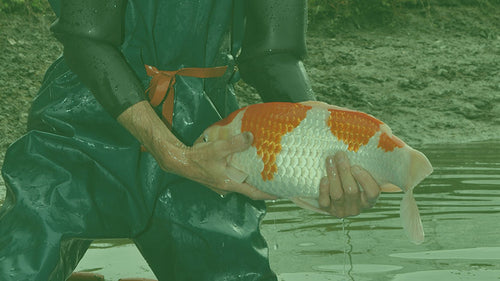
Here, the pattern is supposed to extend over the imaginary line of the dorsal fin. The pattern thus lies on the fish like a saddle. Think of the red pattern of a Kohaku.
In this case, the pattern emerges from below the lateral line, but doesn't cross the imaginary line of the dorsal fin. The fish is thus "clamped" from below by this type of pattern. It's similar to a hair clip where the clamping part is located underneath and the "teeth" grip the fish. Think of the black pattern on a Shiro Utsuri.
These generally involve small patterns that appear fairly randomly on the koi's body, but usually above the lateral line. Consider the black pattern on a Shiro Bekko.
Here, the pattern runs parallel to the lateral line. The pattern can appear either above or below the lateral line, but it is not supposed to cross the imaginary line of the dorsal fin. Think of the black pattern on a Kumonryu.
What is desired?
Initially, the only correct answer is, of course, "what you find beautiful." At koi shows, balance is the key. A large pattern on the front and little to no pattern on the back makes the fish "top-heavy." A lot of pattern on one side and little on the other creates a sense of imbalance, as if the fish could topple over at any moment. Terms that apply to patterns that are best avoided include "top-heavy," "boring," "unbalanced," "too busy," and "one-sided."
In the last part, “Buying Koi,” we focus on the elegance of the fish.


saddle pattern, spot pattern and hairclip pattern linear.
Author: Joop van Tol (Koitoday)

Sign up for our newsletter
Receive the best offers and personal advice.
cookie preferences
To provide you with better, more personalized service, we use cookies and similar technologies. We and third parties use cookies to track your browsing behavior on our website. More information can be found on our privacy policy page.
 Nederlands
 Deutsch


