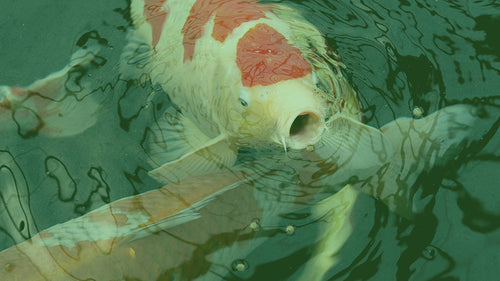
After poor water quality or water chemistry, stress is probably one of the biggest causes of illness in pond fish. Some species are more susceptible to this than others. Goldfish can tolerate a great deal of stress, while ide can withstand very little. Koi fall somewhere in between.
To survive
Stress is actually intended as a survival mechanism. It allows the fish to react incredibly quickly to an acute danger, potentially saving its life. When an acute danger arises, for example, a swipe from a heron or cat, a small chemical factory kicks into gear within the fish. In fractions of a second, hormones (adrenaline, cortisol) are released, enabling the fish to perform at a tremendous pace. Alertness increases, the heart beats faster, blood pressure rises, and blood vessels dilate. All this to increase the transport of oxygen and sugars, enabling the fish to perform superbly, in this case by escaping like a raging Roland. the deadly beak of the heron or the sharp claws of the cat.
Affluence disease
The downside is that during stress, all non-essential bodily functions are put on hold. After all, everything is focused on survival. What good is your immune system in a heron's stomach? Nothing, so the fish's defense mechanism also virtually shuts down during a stressful situation. You can imagine that if stress persists for a long time, causing the immune system to be paralyzed for an extended period, the fish's overall resistance decreases. This makes the fish more susceptible to external invaders (parasites, bacteria, fish gnats), but also to heart failure or the failure of other essential organs. The same applies to humans. We no longer have to perform superhuman feats on the battlefield, but we sometimes face constant work pressure or worries. Stress is therefore the cause of many "lifestyle diseases" in humans.
Stressors
Stressors for pond fish include poor water quality, fluctuating water parameters, incorrect water composition, an unnatural environment, constant external dangers (cats, herons), environmental noise, vibrations, nets, transport, leakage current, and so on.
Prevent (long-term) stress
The moral of the story is that we must prevent prolonged stress, both for ourselves and our fish. Think primarily about excellent water quality and composition, and plenty of hiding places, especially for smaller koi. In short, optimal conditions allow for good general resistance to develop, making the fish resilient. Should you ever want to net the fish or use them in a (koi) show, for example, this won't cause any problems and they will recover quickly. If our fish are healthy, we can relax by the pond. This, in turn, reduces our stress levels.
Author: Joop van Tol (Koitoday)

Sign up for our newsletter
Receive the best offers and personal advice.
cookie preferences
To provide you with better, more personalized service, we use cookies and similar technologies. We and third parties use cookies to track your browsing behavior on our website. More information can be found on our privacy policy page.
 Nederlands
 Deutsch