
The pond design of a natural pond
There are many different ways to design your pond. One thing to keep in mind: to truly enjoy your pond, you need to ensure it fits into the overall look of your garden. So, it's important to take your time!
Ponds can be divided into two categories: the sleek pond and the natural pond. Want to create a natural pond in your garden? Then you're in luck, because I'm going to tell you more about creating one!
Are you more interested in designing a sleek pond? No problem! Here you'll find everything about it design of a sleek pond.
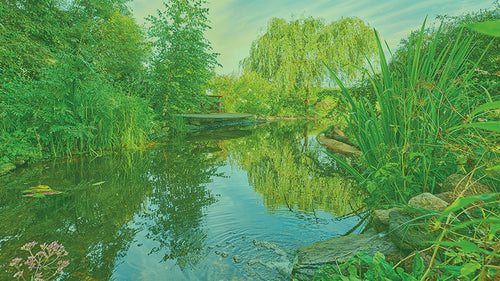
Natural ponds are characterized by the smooth transition between pond and garden. This means that a marsh is used. This means that, if properly constructed, there is no pond liner Visible, the pond seems to have become one with your garden. Just like you see it in nature. That's why it's called a "natural pond." It's a beautiful sight, especially in larger gardens.
When creating the pond design for your natural pond, it's best to follow a few standard steps. These steps can be organized as follows.
First, it is wise to make a plan of your garden and the pond.
On this map Draw your garden, including the pond. Here you can let your imagination run wild, but always keep in mind that the pond should be an integral part of your garden. The location of your pond is also crucial. Ideally, choose a spot where your pond will receive about six hours of sunshine per day. Furthermore, you should also consider things like where the sewer runs, whether paving needs to be removed, whether there are electrical cables running through the garden, and whether there are groundwater issues. These are important factors in your pond design. If you have these things clearly documented, you'll save yourself a lot of frustration later when digging out your pond.
In the second step you make a cross-section of your pond.
Here you'll draw the plateaus for your pond plants and the various depths of your pond. It's important to do this correctly and ensure there are sufficiently large plateaus with varying depths. Make your pond at least 80 to 100 cm deep at its deepest point. This creates sufficient space for your pond plants (part of your planting plan (which I'll discuss later) and sufficient depth for your pond fish. Also, make sure the platforms are level. This seems obvious, but I still encounter many ponds where this isn't the case. As a result, plant baskets "slide" right into the pond, with all the attendant consequences.
In the third and final step, you create the planting plan for your pond.
In this plan, you'll list all the plants you want to use in your pond. This is also where the different depths come into play. Not all pond plants can be planted at the same depth. For example, oxygenating plants like a minimum depth of 50 centimeters, most lilies at 80 centimeters, and yellow irises, for example, at about 15 to 20 centimeters. You can arrange this to your own taste, but make sure you include at least a few of the following pond plants. I also recommend grouping plants together. This maintains the tranquil appearance of your pond and prevents it from becoming cluttered.

Oxygenating plants in your pond.
These ensure that the CO2 is absorbed by the bacteria The oxygenating plants then release oxygen back into your pond water. It's important to leave enough space in your planting plan for these essential plants. Ideally, plant five bunches of oxygenating plants per 1000 liters of water.
Water lily.
The water lily provides shade in your pond and also gives your pond a beautiful appearance! Make sure you plant them in a sufficiently large plant baskets place. This ensures that the roots of your water lily can grow well. A sufficiently high iron value is important for the growth of your water lily.
Marsh plants.
To make your pond edge look as natural as possible, place your bog plants here. Ideally, you've taken shallow areas into account in your pond design. Bog plants come in various varieties, and some can grow at a depth of 40 cm, while others only need to have "wet feet." Bog plants are primarily ornamental, not so much biological. Therefore, I recommend (as I mentioned earlier) planting them in groups to give your pond a beautifully balanced appearance.
Good luck with creating your pond design! Want to know more? Subscribe to our newsletter and receive the latest news straight to your inbox! Convenient, right?
So? Have you properly elaborated on the above points? Then I will congratulate you! You can now start building your pond!

Sign up for our newsletter
Receive the best offers and personal advice.
cookie preferences
To provide you with better, more personalized service, we use cookies and similar technologies. We and third parties use cookies to track your browsing behavior on our website. More information can be found on our privacy policy page.
 Nederlands
 Deutsch


