Ammonia (NH3) is an extremely toxic, highly water-soluble, invisible gas. It consists of one nitrogen atom (N) and three hydrogen atoms (H). Ammonia is harmful to carp at concentrations as low as 0.1 milligrams per liter. That's one part ammonia in 10 million parts water! Ammonia is released as fish digest food. It is therefore a waste product of digestion. Ammonia leaves the fish through the bloodstream and is released into the water through the gills. Contrary to popular belief, the biggest pollutant in a pond is not fish feces and urine, but ammonia released through the gills.
Ammonia (Ammonia Ammonium)
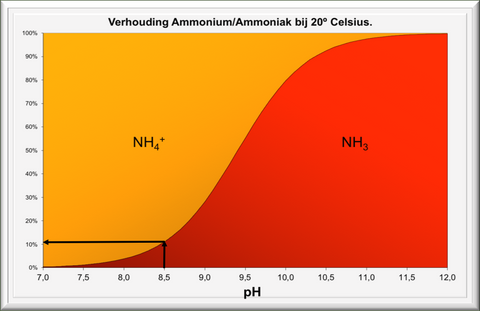
Fortunately for us and our pond inhabitants, most of the released ammonia (NH3) will convert to ammonium (NH4+) in the water . Ammonium is much less toxic than ammonia. The ratio of ammonium and ammonia present in the water (together we call this ammonia) depends on the acidity (pH) and temperature. The higher the pH, the more the ratio leans toward ammonia. Similarly, although to a lesser extent, the higher the temperature, the more the ratio leans toward ammonia.

Test kits
What we do with the test kits The ammonia ( NH3 and NH4 combined ) is what we're measuring. What we really want to know is the amount of ammonia ( NH3 ). After all, that's the dangerous component. To determine this, we need to look up in a table included with the test kit what portion of the ammonia in the water is present as ammonia. This table takes into account the pH and sometimes also the temperature of the water. When the ammonia content exceeds 0.1 milligrams per liter, it is harmful.
Nitrification
Ammonia must be removed from the pond as quickly as possible. This usually requires a biological filter. The article on nitrification in the pond ( https://www.vijverleven.nl/kennisbank/nitrificatie ) describes how this works. If we measure an increase in ammonia levels, it means the nitrification process is not working properly. This can have many causes, which I will discuss later.
Example
Suppose you measure 2 milligrams of ammonia with your test kit. The table shows that the ammonia component is 0.2 milligrams per liter. The ammonium component is therefore 1.8 milligrams (90% of the total). However, the ammonia component is (much) too high at 0.2 milligrams per liter. The fish could be poisoned. We will need to take urgent action!

Author: Joop van Tol (Koitoday)

Sign up for our newsletter
Receive the best offers and personal advice.
cookie preferences
To provide you with better, more personalized service, we use cookies and similar technologies. We and third parties use cookies to track your browsing behavior on our website. More information can be found on our privacy policy page.
 Nederlands
 Deutsch