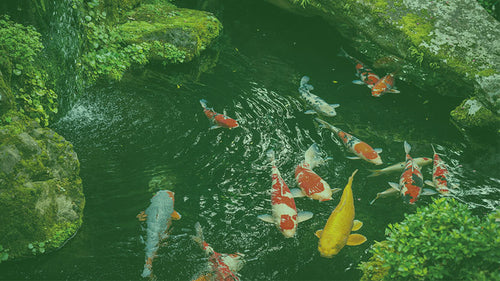
The Kawari Mujimono show class refers to non-metallic, scaled koi (wagoi) without a pattern. Kawari means something like "residual group," indicating that the koi in this class do not belong to any of the other show classes. Muji means "solid" and mono means "pattern." Therefore, a residual group of wagoi without a pattern. The Kawari Mujimono show class is often incorrectly referred to as the group of solid-colored wagoi. This is incorrect. Although solid-colored wagoi also belong to this show class, it also includes multi-colored fish without a pattern. For example, Koi with a matsuba pattern are two - toned. A Shiro Matsuba, for example, is a white fish with black scale centers. Multicolored, therefore, but we don't call it a pattern. We define a pattern as a cluster of scales that differ in color from the fish's base color. In this article, however, I want to discuss the single-colored fish that fall under the Kawari Mujimono.
Preconditions
It's often thought that single-colored fish are easy to breed and that few requirements are met. Nothing could be further from the truth. With a single-colored koi, it's crucial that everything is perfect; after all, there's no fancy pattern that can distract from imperfections. Every deviation in fins, scales, and structure is very noticeable, as are color nuances. A good single-colored koi must have perfect conformation, good skin quality, and an even color.
Popularity
Not all solid-colored koi are popular; some varieties are considered somewhat dull. However, a solid-colored fish, which often has better growth potential than a patterned fish, can create a calming focal point in the pond. Larger specimens, in particular, can be a majestic sight. Of course, there are also GinRin varieties that liven things up a bit (these, however, fall under the KinGinRin B show class).
Color palette
The solid-colored wagoi encompass a wide range of colors, from white to black. The difficulty in identifying the variety lies in the question of when one color ends and the next begins. For example, "karashigoi" means mustard-colored, but mustard can come in many colors, from bright yellow to dark brown. The varieties that fall under the solid-colored, non-metallic wagoi are (from light to dark):
Varieties
Shiro Muji: An all-white koi.
Kigoi: A completely yellow koi.
Soragoi: An entirely light gray to light blue koi.
Midorigoi: A completely light green koi.
Karashigoi: A completely mustard-colored koi.
Benigoi: A completely orange or red koi.
Chagoi: A completely brown koi.
Karasugoi: An all-black koi.
Explanation
Shiro Muji means “white, plain”, Kigoi means “yellow koi”, Soragoi means “heaven, koi”, Midorigoi means “green koi”, Karashigoi means “mustard-colored koi”, Benigoi means “red koi”, Chagoi means “tea-colored koi” and Karasugoi means “raven, koi”.

Author: Joop van Tol (www.koitoday.nl)

Sign up for our newsletter
Receive the best offers and personal advice.
cookie preferences
To provide you with better, more personalized service, we use cookies and similar technologies. We and third parties use cookies to track your browsing behavior on our website. More information can be found on our privacy policy page.
 Nederlands
 Deutsch