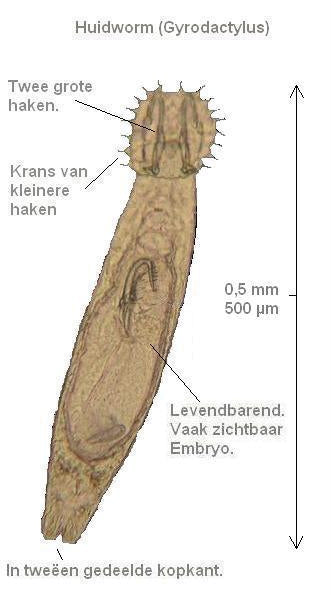
Gyrodactylus is a worm-like organism and therefore multicellular. The worm is about 0.5 millimeters long and, as the name suggests, lives on the fish's skin (ectoparasite), attaching itself with two large hooks and a ring of about sixteen smaller hooks. As you can imagine, the worm can cause considerable damage and irritate the fish. For this reason, an infected fish often makes scraping/flickering movements in the hopes of scraping off the parasite. This often causes the fish to sustain even more damage.
Description
The skin fluke (Gyrodactylus) should not be confused with the closely related gill fluke (Dactylogyres). The skin fluke is viviparous, while the gill fluke is egg-laying. Therefore, a different treatment is required.
The head of the skin fluke absorbs food from the environment and consists of two parts. This immediately reveals the first difference from the gill fluke. The gill fluke's head consists of four parts. However, this distinction is difficult to see through a microscope. A much more distinctive difference is that the gill fluke has four clearly visible "eye spots," which allow it to distinguish between light and dark. These eyespots are absent in the skin fluke. A final significant difference is that the gill fluke lays eggs, and the skin fluke gives birth to live young. If the worm has a visible "embryo" and the four eyespots are missing, you can be sure you're dealing with a skin fluke. Finally, the trained eye will notice the difference in size between the skin fluke and the gill fluke. The skin fluke (0.5 mm) is larger than the gill fluke (0.3 mm).
Cycle
A new young is produced every five to ten days. The rate of reproduction depends on temperature (the higher the temperature, the faster the cycle). Under favorable conditions, a single worm can produce over 2,000 offspring in a single month.

Often, you can already see the next embryo of the next generation within the embryo of the adult worm. So the worm is already "pregnant" before it's born!

Diagnosis
Diagnosis can be made by taking a skin swab. The worm is a relatively large parasite and can be identified at 40x magnification. It's best to use 100x magnification to avoid mistaking skin worms for gill flukes and vice versa.
Treatment
First, identify and resolve the primary cause. Treat with a dewormer in the event of an outbreak (large numbers) and/or visible irritation of the host. Eliminate UV and ozone, and remove absorbents such as activated carbon and zeolite. One treatment is generally sufficient. After seven days, perform a control swab to see if the problem has resolved.
Author: Joop van Tol (www.koitoday.nl)


Sign up for our newsletter
Receive the best offers and personal advice.
cookie preferences
To provide you with better, more personalized service, we use cookies and similar technologies. We and third parties use cookies to track your browsing behavior on our website. More information can be found on our privacy policy page.
 Nederlands
 Deutsch


