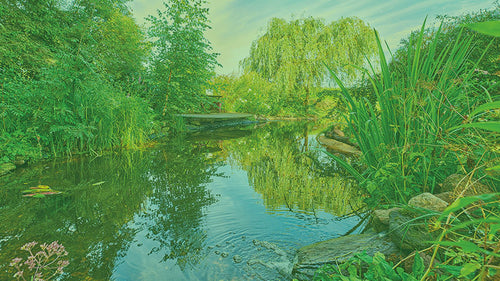
Helophytes is a fancy term for marsh plants. A helophyte filter uses the purifying effect of a marsh to purify or maintain a body of water. When properly constructed, a helophyte filter can convert sewage into water sufficiently purified to be discharged to the surface. This does require a large surface area. With additional post-processing, it can even be converted into drinking water. To keep a pond (swimming or fishing pond) clean, a smaller surface area is sufficient, but a substantial amount of square footage is certainly required.
The operation
Besides the marsh plants that can remove nitrates, phosphates, and metals from the water, it's primarily the bacteria in the marsh's soil that do the "dirty" work. The plants live in symbiosis with these bacteria, for mutual benefit. At the top of the soil, aerobic (oxygen-loving) bacteria are able to convert waste products (such as ammonia and nitrite) into energy for themselves and food (nitrate) for the plants, using oxygen. The plants, in turn, provide sufficient oxygen in the water for these bacteria to do their work. You can increase the capacity of the helophyte filter by providing additional aeration. Deeper in the soil, oxygen is scarce because it has been depleted by the bacteria at the top. Here, bacteria live that, without needing free oxygen, are able to feed on the waste products of the higher-lying bacteria (nitrates). When you regularly harvest plants, you actually remove nutrients from the pond, which have been absorbed by the plants and were created from waste products.
The construction
At the bottom of the tank that will serve as a helophyte filter, drainage pipes will be installed to drain the purified water. These drainage pipes will be placed in a layer of coarse gravel. On top of that, a root cloth will be placed. Several layers of sand will be placed on top of the root cloth: sand mixed with limestone grit at the bottom, sand mixed with iron grit in the middle, and plain sand at the top. Pipes that will supply the wastewater and distribute it across the surface will be placed on the top layer of sand. Finally, the entire area will be covered with a layer of gravel, into which the marsh plants will be planted. The water will flow vertically through the soil from top to bottom, with bacteria converting the wastewater into building blocks that the plants use to grow. For more information, see: https://www.saniwijzer.nl/technieken/verwerking-afvalwater/natuurlijke-systemen/helofytenfilter-conventioneel

Which plants?
Reeds like the yellow iris, in particular, are strong, grow rapidly, and are also beautiful when they flower. An added advantage is that you can prune them back to about ten centimeters without any problems if they threaten to become overgrown.
No room for a complete helophyte filter?
Then you might be interested in a plant filter. These are easy to install along the pond's edge, provide additional filtration, and the waterfall creates falling water and therefore oxygen in your pond! The plant filters are available in five sizes: 75cm, 100cm, 125cm, 150cm, and 187cm. Curious about the possibilities? Click here!
Author: Joop van Tol (www.koitoday.nl)

Sign up for our newsletter
Receive the best offers and personal advice.
cookie preferences
To provide you with better, more personalized service, we use cookies and similar technologies. We and third parties use cookies to track your browsing behavior on our website. More information can be found on our privacy policy page.
 Nederlands
 Deutsch


