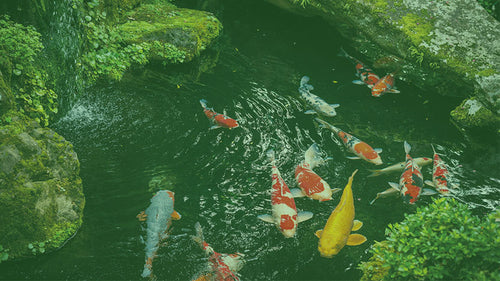
A rapidly emerging and currently very popular koi variety is the Goshiki. Goshiki is a fish with a white base color (shiroji), a red (hi) pattern, and gray to black markings (anime) on the white base color, and optionally also on the red pattern. With Goshiki, the anime must be present on the white and may also be present on the red pattern. The hi pattern can be described as a "saddle pattern" ( Buying Koi Part 4 ). Essentially, it's a Kohaku with the anime added as a bonus. Goshiki literally means "five-colored." Go is Japanese for five, and (ni)shiki means colored. However, a good Goshiki has only three colors: white, red, and one of the following five colors: gray, blue, indigo, purple, or black. In other words, the markings (anime) are only one of the five colors: gray/blue/indigo/purple/black, and therefore a mixture of these is preferred (a drawback). In that respect, the name "five-colored" is a bit of a misleading one. Goshiki, along with Goromo ( Goromo ), falls under the Koromo show class. This means that Goromo and Goshiki compete against each other at koi shows.
Origin
The first Goshiki were crosses between Aka Bekko and Asagi. These Goshiki had the anime on both the white base color and the red pattern. A disadvantage was that the red color (due to the red base color of the Aka Bekko) was often very dominant. The quality of this variety has increased significantly in recent decades, as Goshiki have been produced from crosses between Sanke ( Sanke ) and Asagi ( Koi varieties: Asagi and Shusui ). This gave rise to the Ukimi Goshiki. In this variety, only the white base color has the anime, resulting in a clean red pattern that sits like islands within the veiled white base color. Goshiki with only the anime on the white create a more subdued appearance and are much more popular than traditional Goshiki.
Breeding
Although there are no breeders in Japan who produce exclusively Goshiki, some breeders do exhibit a high degree of specialization in Goshiki. Kanno, Hiroi (Conias), and Aoki, for example, sometimes offer very fine specimens. Furthermore, there are several "bulk breeders" with a wide range of varieties who also include Goshiki in their selection. The selection criteria for young Goshiki are very similar to those of Kohaku and Goromo. The anime often only appears later in life, so it cannot be selected for in the first rounds. The danger with Goshiki is that the anime becomes too dominant. The later it appears, the better it generally is. What we look for is a subtle veil on the pristine white base color. Especially in "hard" water, such as is common in the Netherlands, the markings quickly become too much.
Subvarieties
Besides the traditional Goshiki and the Ukimi Goshiki, there is also the Kuro Goshiki. Kuro means black. In this case, the anime is very dominant, overshadowing the entire white base color, making the fish look very similar to a Hi Utsuri. This can be very beautiful, as long as the red pattern doesn't become "contaminated." Unfortunately, this happens more often as the markings become more dominant.


Author: Joop van Tol (www.koitoday.nl)

Sign up for our newsletter
Receive the best offers and personal advice.
cookie preferences
To provide you with better, more personalized service, we use cookies and similar technologies. We and third parties use cookies to track your browsing behavior on our website. More information can be found on our privacy policy page.
 Nederlands
 Deutsch


