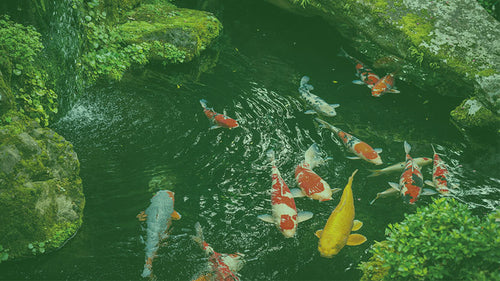
The Kujaku is probably the most popular metallic patterned variety in the koi scene. There's even a Japanese breeder (Kaneko) who specializes primarily in this variety. You can read about the origins of metallic koi, called Hikari in Japanese, in Manifestations of koi. To identify a Hikari koi, it's best to look at the head/shoulder area and the pectoral fins; these should have a metallic sheen. The pectoral fins are also colored all the way to the tip, while Wagoi (non-metallic, scaled koi) usually have a transparent section at the tip.
Kujaku is a koi with a white base color, a red saddle pattern, and gray to black scale markings on both the red and white. The observant reader will immediately recognize the Goshiki from the recent article about this koi ( Goshiki ). And they're right! Kujaku is actually the metallic variant of Goshiki, although this association is often overlooked because Kujaku has a very different appearance than Goshiki. However, Kujaku was created by crossing a Goshiki with a Purachina (Platinum Ogon, a metallic, all-white koi).
Kujaku is the Japanese word for peacock, and indeed, if you look at the matsuba-like black markings on the metallic background, it does resemble shimmering peacock feathers. A (male) peacock has an overwhelming display of color that's sure to impress, and this parallel can be extended to Kujaku, who displays an explosion of color in the pond. If this Kujaku also has GinRin scales, then you can truly call it a multicolored glitter ball from the 1970s.
Kohaku are classified in the Hikari Moyomono class at Showa. This refers to metallic, patterned varieties that lack a black base color. These show classes also include fish such as Kin Fuji (metallic Kohaku), Yamato Nishiki (metallic Sanke), and Hariwake. The only subvarieties of Kujaku are Tancho Kujaku, where the only red is in the form of a dot on the head, and Ki Kujaku, where the red is replaced by yellow.
As far as I'm concerned, I'm still waiting for a Kujaku, where the black scale markings appear only on the white base color, making the red patterns appear to float on it like islands. This is essentially the trend that began with the modern Goshiki (Ukimi Goshiki) and continues in its metallic counterpart.
In summary, we can regard the Kujaku as a welcome guest that should not be missing from any pond.

Author: Joop van Tol (www.koitoday.nl)

Sign up for our newsletter
Receive the best offers and personal advice.
cookie preferences
To provide you with better, more personalized service, we use cookies and similar technologies. We and third parties use cookies to track your browsing behavior on our website. More information can be found on our privacy policy page.
 Nederlands
 Deutsch