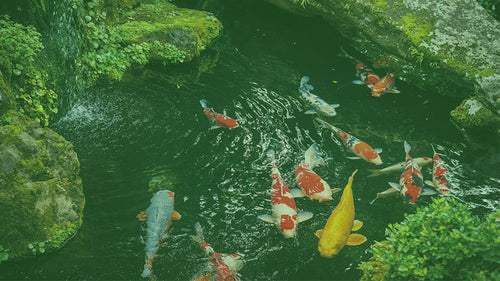
Matsuba isn't a koi variety, but a phenomenon that occurs in several varieties. Matsuba is the Japanese word for pine cone. It describes black scales embedded in the skin. This skin between the scales is called Fukurin and is actually the koi's base color. When the koi's base color is white, you get a white fish with black scales (cores).
Origin
As is well known, all koi varieties are descendants of the original carp, called Magoi in Japanese. These Magoi were bred as edible carp from the 19th century onward. There were three types of Magoi, one of which was the "Agagi Magoi," which already possessed the characteristic of black scales against a dark brown skin. This is where the name Matsuba comes from, as the comparison to a pine cone is apt!
The Asagi Magoi is the basis of the Matsuba varieties we know today.

Cartridge
Although I call this paragraph a pattern, and the term "Matsuba pattern" is often used, the "Matsuba effect" should not be considered a pattern. Patterns in koi are areas of multiple scales in a single color that deviate from the base color. This doesn't apply to Matsuba, where each scale is black and the surrounding skin is a different color. Most Matsuba have no pattern and therefore fall under the Mujimono classes. Blog Subvarieties
Wagoi
The first Matsuba varieties were, of course, the wagoi (scaled, non-metallic carp), with the Asagi being the first koi with Matsuba markings to see the light of day. Later, white (Shiro Matsuba), red (Hi Matsuba), and yellow (Ki Matsuba) koi were bred.
Hikari
Of course, metallic varieties of the Shiro Matsuba (Gin Shiro Matsuba), Hi Matsuba (Kin (Hi) Matsuba), and Ki Matsuba (Kin (Ki) Matsuba) also existed. Gin is used for metallic koi with a silver sheen (on white, gray, and black koi), and kin for metallic koi with a golden sheen (on yellow, orange, and red koi). In metallic fish, the skin between the scales (Fukurin) creates the metallic look. In metallic red and yellow Matsuba, the color (Hi or Ki) is often omitted from the name. Therefore, when the name Kin Matsuba is used, it's unclear whether a red-metallic or yellow-metallic variety is meant.
Doitsu!
Yes, Matsuba also occurs in Doitsu. This might sound strange to you, because weren't Doitsu koi without scales? Well, not quite. Doitsu also include so-called scaleless varieties. Koi with, for example, only a row of scales on either side of the dorsal fin. When these are black and the rest of the body (the base color) is a different color, we also call them Matsuba. These include the Doitsu Shiro Matsuba, the Doitsu Hi Matsuba, and the Doitsu Ki Matsuba.
Doitsu Hikari
You could almost have guessed it yourself... Of course, Doitsu Matsuba also came in metallic versions. We know the Doitsu Gin Matsuba, a white metallic fish with only rows of black scales on either side of the dorsal fin; the Mizuho Ogon, a red metallic fish with only rows of black scales on either side of the dorsal fin; and the Ki Mizuho Ogon, a yellow metallic fish with only rows of black scales on either side of the dorsal fin. It's worth noting that the names of the latter two differ from what you might expect (Doitsu Kin Matsuba).


Author: Joop van Tol (www.koitoday.nl)

Sign up for our newsletter
Receive the best offers and personal advice.
cookie preferences
To provide you with better, more personalized service, we use cookies and similar technologies. We and third parties use cookies to track your browsing behavior on our website. More information can be found on our privacy policy page.
 Nederlands
 Deutsch