In the article " Temperature (Part 1) " I indicated that the temperature tolerance for koi ranges from 4 to 25 degrees Celsius. In this article, we'll explore this further.
Too cold
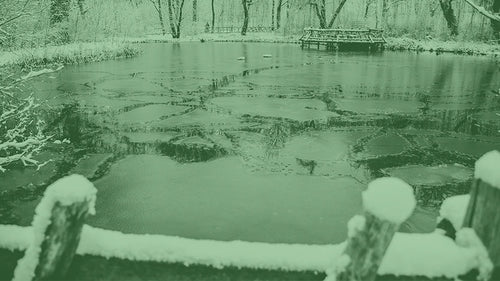
From the above, we can deduce that a temperature below four degrees Celsius is unsuitable for keeping koi. Many people assume that koi can easily be kept in colder water. "There's often a layer of ice on the ditches in winter, and those carp don't die anyway..." is a frequently cited argument. However, this reasoning is incorrect. To explain this, you need to know that water at four degrees Celsius has the highest density (this is a physical fact). It is therefore the heaviest and sinks to the bottom. In nature, this means that the water at the bottom of a deep ditch or pond is four degrees Celsius and therefore warmer at the top, where a layer of ice has formed. The carp seeks out this four-degree zone when it freezes and goes into hibernation. Koi are therefore not naturally (evolutionarily) adapted to water colder than four degrees. In our ponds, we don't achieve this "layering" of water with different temperature zones, because we have a relatively small volume of water that's constantly being mixed by pumps, bottom drains, and swimming movements. If it's zero degrees at the top, it's zero at the bottom too!
When a koi's water temperature drops below four degrees Celsius, it doesn't enter hibernation mode, but rather survival mode. This doesn't mean it will die, but it will weaken it. These are the ponds where problems are expected in the spring due to weakened fish with low resistance. Therefore, ensure the pond doesn't drop below four (preferably six) degrees Celsius. This can often be achieved by using a cover to block out the cold wind. Insulating the pond during construction or possibly adding some heating are also options.

Too hot
Above 25 degrees Celsius, even in a hygienic pond (clean with little organic pollution), it's difficult to get enough oxygen into the water for optimal filter and fish performance. Warm water simply holds less oxygen than cold water (this is also a physical phenomenon). For this reason, it's unwise to let the temperature rise above this limit. Fortunately, this rarely occurs naturally in the Netherlands, unless you have a shallow pond or one with a small water volume. When water temperatures are high, ensure you aerate the pond well and keep it clean. This prevents the scarce oxygen from being wasted on rotting processes, which the fish and filter desperately need.
Optimal
The optimal temperature for koi is approximately between 20 and 24 degrees Celsius. This temperature range allows the fish to optimally build up resistance, recover from wounds and the like, digest food, and grow.

Finally
Although the temperature range for koi is wide, it's important to make temperature changes very gradually. This gives the fish time to adjust its metabolism to the new environment. Don't move fish from cold to warm all at once, and certainly not from warm to cold.
Author: Joop van Tol (www.koitoday.nl)

Sign up for our newsletter
Receive the best offers and personal advice.
cookie preferences
To provide you with better, more personalized service, we use cookies and similar technologies. We and third parties use cookies to track your browsing behavior on our website. More information can be found on our privacy policy page.
 Nederlands
 Deutsch


