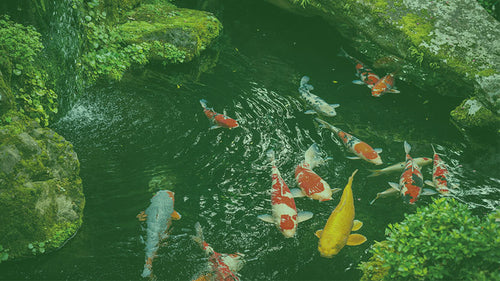
When it comes to the most popular single-colored metallic fish, besides the Purachina (Platinum Ogon), the Yamabuki Ogon is definitely in the top three. Yamabuki is a completely yellow (gold) metallic koi. It's essentially the metallic variant of the Kigoi (a non-metallic, yellow wagoi). While the non-metallic Purachina (Shiro Muji) isn't popular, the non-metallic Yamabuki certainly is. The hard-to-find Akame Kigoi is particularly sought-after. Akame stands for red eyes. It's a kind of albino variant of the Kigoi—in short, a yellow fish with red eyes. The Yamabuki Ogon falls into the show class Hikari Mujimono (metallic wagoi without a pattern).
To arise
As indicated in the article on Purachina, all metallic koi varieties descend from the color mutant purchased by Sawata Aoki, which was caught in a river in the 1920s. This mutant had several "gold stripes" in the dorsal fin. In the mid-1950s, Aoki produced his first Yamabuki, logically by crossing a Purachina with a Kigoi. Yamabuki takes its name from a yellow wild rose that grows in Japan among the mountains and along the rivers. Literally translated, it means something like "fresh breath in the mountains." The Aoki Koifarm, which was later founded, is still considered one of the leading Japanese breeders of Hikari (metallic) varieties.

Popularity
The Yamabuki is exceptionally popular due to its growth potential and golden color, which, in good specimens, creates a beautiful display in sunlight. Especially in a pond with Go-Sanke, such as those common in Japan, it is a real eye-catcher, creating a beautiful contrast with the red, white, and black colors of this group. Specimens over 80 centimeters are particularly impressive. Izumya has been the leading koi farm for Yamabuki for decades. Senichi Mano, the breeder, has specialized extensively in producing jumbo Yamabuki with a beautiful, intense golden yellow color.
To demand
Any deviation in the body and skin quality of solid-colored fish is mercilessly penalized when we judge them. After all, there's no pattern to camouflage flaws (distraction), and color gradients are an eyesore. Therefore, we prefer a uniform color tone across the entire body and a body in which everything is perfect (shape, size, and symmetry of the fins, neatly aligned scales, and a sheen throughout). The fukurin (the skin between the scales) creates the sheen and is extremely important. Tip when buying a Yamabuki: Choose a light-colored variety; dark yellow specimens often develop orange patches as they grow larger and older.
Variants
Of course, there's also a doitsu (scaleless) variety of Yamabuki, and one with ginrin. These are not often seen and are considerably less popular than the Yamabuki as wagoi (scaled and without gingin).
So if we list the completely yellow koi, we get the following six varieties:
Wagoi, non-metallic: Kigoi
Wagoi, metallic: Yamabuki Ogon
Doitsu, not metallic: Doitsu Kigoi
Doitsu, metallic: Doitsu Yamabuki Ogon
Wagoi, non-metallic with ginrin: GinRin Kigoi
Wagoi, metallic, with ginrin: GinRin Yamabuki Ogon


Author: Joop van Tol (www.koitoday.nl)

Sign up for our newsletter
Receive the best offers and personal advice.
cookie preferences
To provide you with better, more personalized service, we use cookies and similar technologies. We and third parties use cookies to track your browsing behavior on our website. More information can be found on our privacy policy page.
 Nederlands
 Deutsch


