Finally, the time has come. After months of preparation and hard work, your pond is finally ready to welcome new inhabitants. ( Click here for part 1 ) Choosing koi is often a highlight in the hobby. Don't let this turn out to be a low point, so stay focused despite this joyful occasion. Take your time, don't be rushed, and make your choice preferably in daylight. Sometimes, when in doubt, it's wise to take a decision so you can make a final decision with a fresh perspective the next day or week. Remember that with proper care, you'll be stuck with this animal for years to come. This article explains the first aspect to consider when purchasing koi: the body.
Body
The fish's body is the most important aspect. Many beginning hobbyists are tempted by vibrant colors or a cute pattern as the primary consideration when purchasing a new koi. However, if the fish's body isn't perfect, all this pales in comparison to its growth. Any flaws that may not be very noticeable as a tosai (yearling) will become significantly more pronounced later in life.
External characteristics
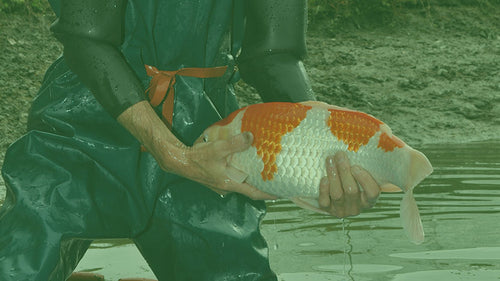
When assessing the body, keep balance and symmetry in mind. First, ensure that all the fish's components are present. Seven fins (two pectoral fins, two ventral fins, one anal fin, one dorsal fin, and one tail), two eyes, four barbels (at least the two largest ones), and no missing scales where they should be. Be aware of wounds and scars, and check for torn fins. Ensure that there are no visible ectoparasites such as carp lice, anchor worms, or leeches.
Next, observe the fish as if there were no color or pattern, but rather just the contours. Check that the fish isn't crooked or that its head isn't tilted relative to its body. Also check that the koi is symmetrical (for example, that the left side isn't more convex than the right, or that the left pectoral fin is shaped differently or is a different size than the right). The fish should have a nice zeppelin shape, with the widest point just behind the gills. The line should form a smooth arc along the outside of the fish. Check that the gills close neatly and, when closed, continue in a single, flowing line to the rest of the fish. Ensure that the scales are evenly sized and aligned. Ensure that everything is in proportion. A large fish with a thin tail or a head that is too small will become increasingly unappealing as it grows.
Of course, there are a thousand and one rules that the perfect koi should ideally meet in terms of body. It's beyond the scope of this article—you'd need a book for that—but this way you'll have the most basic information covered, and the risk of a pig in a poke is significantly reduced. Of course, you can also seek advice from the dealer or an experienced hobbyist. However, always remember that your taste is paramount, and you "have" to look at this fish for years. So, only use advice from others to avoid a bad purchase, not to buy something different than your taste dictates.


Author: Joop van Tol (Koitoday)

Sign up for our newsletter
Receive the best offers and personal advice.
cookie preferences
To provide you with better, more personalized service, we use cookies and similar technologies. We and third parties use cookies to track your browsing behavior on our website. More information can be found on our privacy policy page.
 Nederlands
 Deutsch


