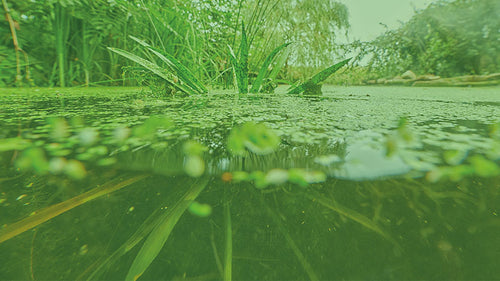
One of the major water quality hazards is pH crashes. As the name suggests, this means the pH can drop to a lethal level for pond inhabitants in a very short time. pH crashes are relatively common, which is unfortunate, because they can be prevented with a few simple measures.
Acidity
The pH refers to the acidity of water. The scale ranges from 0 to 14. The lower the pH, the more acidic the water. At a pH of 7 (exactly in the middle of the scale), the water is neutral (neither acidic nor basic). A pH crash, therefore, means the water can become very acidic in a very short time. Fish cannot tolerate this. A carp, for example, prefers a pH between 7 and 8. A pH that deviates from this level causes stress by disrupting various bodily functions. A pH below 5 is usually even fatal. I will discuss pH in more detail in a future article. 
Cause
In my article on the nitrification process ( https://www.vijverleven.nl/kennisbank/nitrificatie ) I explained that converting ammonia via nitrite into nitrate releases a lot of hydrogen (H + ) and that this has an acidifying effect on the pond. In my article on KH ( https://www.vijverleven.nl/kennisbank/wat-is-het-belang-van-kh-voor-jouw-vijver ) I indicated that Karbonat Härte (Carbonate Hardness) prevents the hydrogen from directly affecting the acidity, because the carbonates and bicarbonates that make up KH neutralize the acid (H + ) that is released. However, by neutralizing the constantly produced hydrogen, the (bi)carbonates are used up and the KH will therefore decrease.
Consequence
Once the KH is completely depleted, the hydrogen will directly affect (lower) the pH. This can happen very quickly. Within a few hours, a pH of around 7 can drop to below pH 5 (crash!). The result is a pond full of dead and half-dead fish. I regularly visit ponds where such a crash has occurred. The night before, everything was fine, and the fish were swimming happily. The next morning, the pond was a slaughterhouse. A lot of unnecessary suffering for the fish and their owners.
Measures
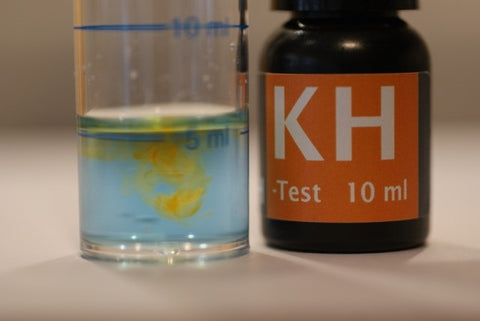
Preventing a pH crash is simple. Measure the pH and KH very regularly. Make sure the KH is no more than one degree lower than the KH of the tap water. If the tap water already has a low KH (4 degrees German Hardness or lower), consider a means to increase the KH Raise the pond's pH a little. Generally, sufficient water changes will be enough to maintain the KH level. If the KH has dropped by more than one degree compared to your tap water, you will need to change more water. Also change sufficient water in the winter. Most crashes I encounter in practice occur around winter because many people don't realize that the nitrification process continues in winter. While it may be at a slower pace because less or no feeding is done, it continues because the fish are using up their reserves, thus releasing ammonia that must be converted by the biological filter.
Author: Joop van Tol (Koitoday)

Sign up for our newsletter
Receive the best offers and personal advice.
cookie preferences
To provide you with better, more personalized service, we use cookies and similar technologies. We and third parties use cookies to track your browsing behavior on our website. More information can be found on our privacy policy page.
 Nederlands
 Deutsch