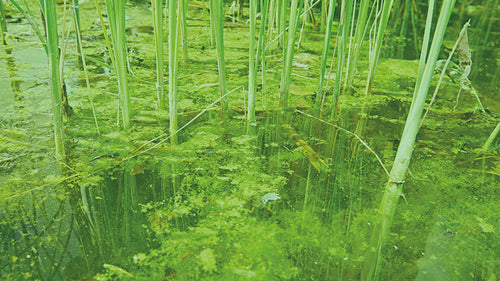
Many pond owners dread the thought alone. Algae can become a real plague in a pond. Filamentous algae can clog the system, or floating algae can make it difficult to see a few centimeters into the pond. Some pond owners become so discouraged that they resort to heavy-duty measures. This is a very unwise decision, as will become clear later in this article.
Algae are actually very simple plants that come in many different varieties and sizes. Floating and filamentous algae are the most familiar forms for pond enthusiasts. These algae, like green plants, can produce their food from carbon dioxide and water by converting it, with the help of sunlight, into glucose (which provides the plant with energy) and oxygen (which is a waste product for the plant). This is called photosynthesis.
In addition, algae use phosphate to build cells nitrates and phosphates . However, algae can also directly absorb ammonium and that is why they often become a pest in the spring. By starting to feed too enthusiastically while the nitrification If the process has not yet started sufficiently, an excess of ammonia will arise in the water, giving algae the opportunity to develop explosively.
Excessive and therefore bothersome algae blooms can occur in the pond due to a combination of an excess of nutrients (nitrates and phosphates), direct sunlight, a plant-friendly amount of carbon dioxide (between 10 and 40 milligrams per liter) and ammonia.
To prevent algae explosions you can take the following measures:
If, despite precautions, an algae outbreak does occur, don't tackle it with a product that kills the algae in one fell swoop. After all, algae are Mother Nature's solution in her quest for a healthy balance. Due to the massive algae loss, you can expect an ammonia spike, partly because the algae no longer absorb ammonium, and partly because the death of the algae actually releases extra ammonia. Furthermore, many algae control products are based on heavy metals, which are harmful to fish. These metals can accumulate in the fish's organs, potentially leading to organ failure. Try to tackle an algae outbreak carefully:
In some cases, filamentous algae can become an annual nuisance, despite the aforementioned precautions. Bottom drains can clog with the growth of several meters of algae. In that case, you might consider using a non-harmful algaecide once in the spring. Do this as soon as the filamentous algae starts growing again, not when the filaments are already several meters long. This allows you to use a small dose and prevents ammonia spikes caused by massive algae die-off. An effective and organic product is Active Pond Green Control.
Author: Joop van Tol (www.koitoday.nl)

Sign up for our newsletter
Receive the best offers and personal advice.
cookie preferences
To provide you with better, more personalized service, we use cookies and similar technologies. We and third parties use cookies to track your browsing behavior on our website. More information can be found on our privacy policy page.
 Nederlands
 Deutsch