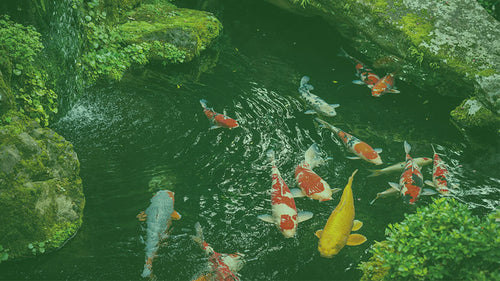
Thaiso Sanshoku
Taisho Sanshoku, as the Sanke is officially called, is one of the three main players in the koi scene. Along with Kohaku and Showa, the Sanke belongs to the group sometimes referred to as Go-Sanke. Go-Sanke is a term from the Edo period (1806–1868) and means "three honorable houses." It should be noted that Edo was the former name of Tokyo, where the shogunate (and therefore the power) was located. Varieties from the Go-Sanke group are, on average, far more popular than all other varieties combined. The literal translation of Sanke is tricolor, referring to the white (shiroji) base color with a red (Beni) and black (Sumi) pattern on top.
Origin
The Sanke variety was created at the beginning of the last century by crossing a Shiro Bekko with a Kohaku. A logical cross, because a Shiro Bekko is a white fish with small black patterns (spotted pattern) and a Kohaku is a white fish with large red patterns (saddle pattern). By combining these, the Sanke was created; a white fish with a red saddle pattern and a black spot pattern. It should be emphasized that we are talking about a variety, not a breed. With a breed, all offspring share the same characteristics. With a variety, you can also expect offspring that, in this case, can be completely white (Shiro Muji), completely red (Benigoi), or with no black (Kohaku) or no red (Shiro Bekko).
Breeding
A number of breeders in Japan specialize, or co-specialize, in Sanke. Think of Momotaro, Yamamatsu, Matsunosuke, Marusyo (Tanaka), Konishi, Ikarashi, and Sakai SFF. However, Sanke has driven many breeders to despair. It's one of the most difficult varieties to breed high-quality. You're essentially looking for a perfect Kohaku, which is already a huge challenge, but also high-quality sumi (black) that must be present in the right quantity, size, and location! Difficult (understatement). The sumi, in particular, is often the show-stopper. This sumi only develops later in life and must then meet all the aforementioned requirements. This means the breeder must keep larger numbers of fish for a longer period of time, hoping to retain a few good Sanke. Keeping fish costs money (water, energy, housing, food). The few good Sanke then have to cover the costs of all the discards.
Subvarieties
Over the course of the last century, four sub-varieties of the Sanke emerged. These are:
In addition to these wagoi (scaled variants), Sanke is of course also available in a Doitsu (scaled) and Hikari (metallic) version.


Author: Joop van Tol (Koitoday)

Sign up for our newsletter
Receive the best offers and personal advice.
cookie preferences
To provide you with better, more personalized service, we use cookies and similar technologies. We and third parties use cookies to track your browsing behavior on our website. More information can be found on our privacy policy page.
 Nederlands
 Deutsch