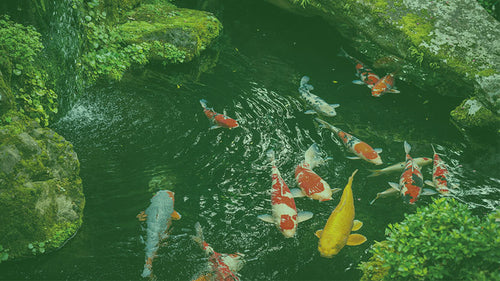
Showa Sanshoku
Showa Sanshoku, as the Showa is officially called, is one of the three main players in the koi scene. Along with Kohaku and Sanke, the Showa belongs to the group sometimes referred to as Go-Sanke. The three varieties in the Go-Sanke group are by far the most popular fish in the koi scene. The Showa owes its name to the era in which it originated. The Showa Jidai ran from 1926 to 1989, the reign of Emperor Hirohito (also known as Emperor Showa). Of these three, you could call the Kohaku the most elegant fish, and the Showa the most robust.
A Showa is a koi with a black base color and a red and white pattern. Many beginning hobbyists struggle to distinguish between a Sanke (which also has white, black, and red) and a Showa. However, they are completely different fish with different origins. For example, unlike a Showa, a Sanke has a white base color.
Origin
In 1927, Jukichi Hoshino was the first man to create a Showa by crossing a Ki Utsuri (a black koi with a yellow pattern) with a Kohaku. Don't expect too much from this fish; it was a grayish-black koi with a yellowish-red pattern. The Showa really became popular in 1964, thanks to Tomiji Kobayashi, a hobbyist himself! He crossed a Yagozen Kohaku, significantly improving the fish's coloration in all three. After that, things took off. The Showa became an incredibly popular variety, especially after one of Kobayashi's fish became the first Showa to ever win the All Japan Show. This is the most important koi show in the world. The Grand Champion of that show can call themselves world champion. Many more Showa champions followed, in recent decades even more than the Sanke.
Breeding
In Japan, several breeders specialize in Showa koi. These include Dainichi, Isa, Oomo, and Ueno. Like all other koi, Showa koi are varieties, not breeds. While all offspring of a breed share the same color and markings, varieties can also differ in color and therefore be classified as different varieties. For example, offspring of Showa koi without white are Hi Utsuri, and offspring without red are Shiro Utsuri. The initial selection of Showa koi is simple and can be done shortly after hatching. The black koi are kept, and the rest are discarded. The second selection takes place when the koi have largely lost their black color and the red pattern is visible. The koi with a reasonably good "Kohaku" pattern are kept, and the rest are discarded. Then, it's a matter of waiting to see whether the reappearance of black koi transforms them into beautiful Showa koi. It's important for Showa koi to have evenly distributed colors across the body, and for all three colors to be present on the head.
Subvarieties
Showa koi has its own show class, "Showa," at koi shows. This class includes several subvarieties. The Kobayashi Showa is the traditional variety with a lot of black. A Kindai Showa has much less black and therefore more white. A Hi Showa, on the other hand, has a lot of red and therefore little white.


Joop van Tol (www.koitoday.nl)

Sign up for our newsletter
Receive the best offers and personal advice.
cookie preferences
To provide you with better, more personalized service, we use cookies and similar technologies. We and third parties use cookies to track your browsing behavior on our website. More information can be found on our privacy policy page.
 Nederlands
 Deutsch