Appearances of koi
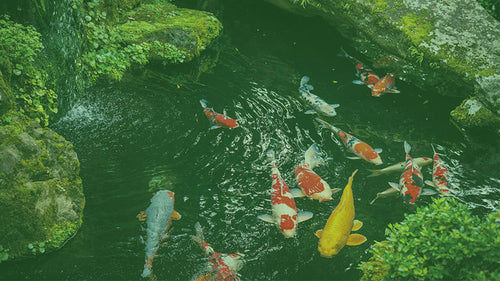
Koi can be divided into specific categories based on their appearance. I'm not referring to the many varieties we know, which are often defined by color and pattern, but rather the "layer" above that.
Wagoi:
Wagoi are full-scale koi. This is the origin of the koi hobby. Rice farmers from Niigata, Japan, kept scaled carp in wooden tanks under their houses to supplement their diet of primarily rice. Sometimes these carp exhibited a color mutation, such as a brown carp with a few yellow spots. This mutation led to the development of Nishikigoi (popularly abbreviated to koi), which literally translates to "colored carp."
Doitsu:
Doitsu are scaleless or scaleless carp. This variety has no scales, or only scales along the lateral line and/or along the dorsal fin. Doitsu means "German" in Japanese, thus referring to their origin. At the end of the 19th century, the Japanese Fisheries Department purchased a number of leatherbacks and mirror carp from a monastery in German-speaking Austria. These were intended to breed scaleless carp for consumption in Japan. They had the advantage of being easier to prepare (no scales need to be removed) and possessed more "meat" than the scaled variety. Naturally, these Doitsu were also bred into the Nishikigoi lines, resulting in Doitsu koi.
Hikari
These are metallic wagoi. This form originated around 1920. Sawata Aoki, a hobby breeder, heard that a special carp had been caught in a river. It was supposedly a carp with "golden" stripes in its dorsal fin. Aoki went to see this remarkable "natural phenomenon" and bought the fish for a hefty sum. By selectively breeding this fish, the first Hikari (metallic) koi were created. Naturally, these metallic fish were also bred into the Doitsu lines, so that Doitsu Hikari koi are also produced.
Hiragana
Hiragana refers to koi with long fins. They are better known as butterfly or longfin. This form gradually evolved through selective breeding of fish with large fins to achieve increasingly longer fins. It has been received with varying degrees of enthusiasm among "traditional" koi enthusiasts. They come in Wagoi, Doitsu, and Hikari forms.
Bonsai:
Bonsai koi are specifically bred for aquariums. They are therefore (intentionally) slow growers that often expand in width, giving them a somewhat balloon-like body shape. The average koi enthusiast isn't thrilled about this, but there are enthusiasts, so they are bred.



Sign up for our newsletter
Receive the best offers and personal advice.
cookie preferences
To provide you with better, more personalized service, we use cookies and similar technologies. We and third parties use cookies to track your browsing behavior on our website. More information can be found on our privacy policy page.
 Nederlands
 Deutsch


